01
Tickets & opening times
Current prices, the free last-Sunday slot, Friday evening openings, and how the 5 euro booking fee works.
Vatican City · Independent guide
The Sistine Chapel is the private chapel of the Apostolic Palace in Vatican City, built between 1473 and 1481 for Pope Sixtus IV and painted by Michelangelo Buonarroti between 1508 and 1512, then again between 1536 and 1541. It is also the room in which cardinals elect a new pope.
This guide exists because the practical questions — what a ticket costs, when the queue is shortest, what you are allowed to wear, what you should look at once you are inside — are scattered across dozens of sites. Everything here is checked against the official Musei Vaticani website and updated when the Vatican changes its rules.
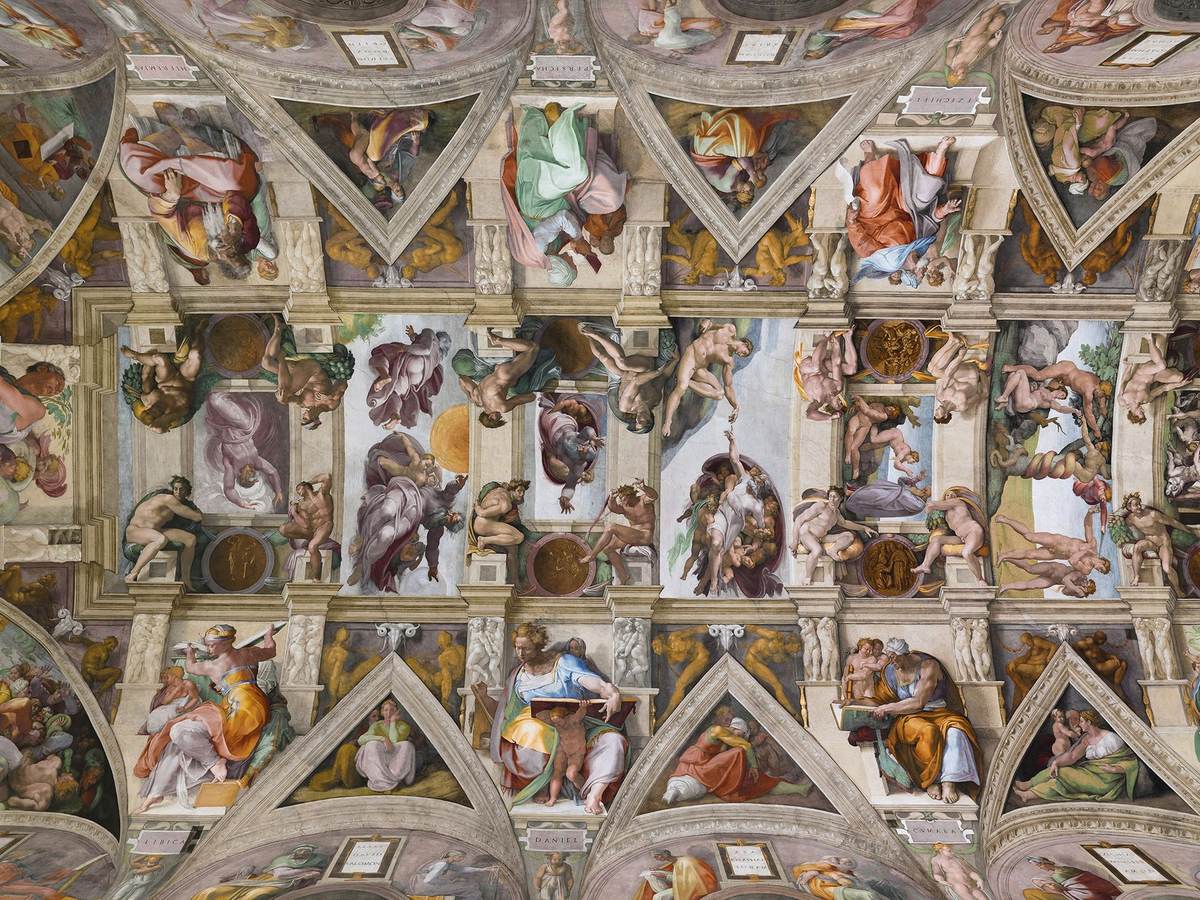
Michelangelo's ceiling covers roughly 460 square metres and contains more than 300 figures.
The Sistine Chapel is a rectangular brick hall measuring 40.9 metres long, 13.4 metres wide and 20.7 metres high. Those proportions are not accidental: they match the dimensions given for the Temple of Solomon in the First Book of Kings. The architect was Baccio Pontelli and construction was supervised by Giovannino de' Dolci, who completed the shell in 1481. The chapel takes its name from the pope who commissioned it, Sixtus IV della Rovere.
Before Michelangelo ever touched it, the chapel already held one of the finest fresco cycles in Europe. In 1481–82 a team including Pietro Perugino, Sandro Botticelli, Domenico Ghirlandaio, Cosimo Rosselli and Luca Signorelli painted the side walls with parallel Lives of Moses and Lives of Christ. Most visitors walk straight past them while looking up.
The ceiling came later. Pope Julius II pressed a reluctant Michelangelo — who considered himself a sculptor, not a painter — into repainting the vault. He worked from 1508 to 1512, standing on a bracket scaffold of his own design, and produced nine scenes from Genesis framed by prophets, sibyls and the twenty muscular ignudi. Almost a quarter of a century later, under Popes Clement VII and Paul III, he returned to paint The Last Judgment across the altar wall between 1536 and 1541.
Read the full story on our history of the Sistine Chapel, or jump to the twelve details worth finding inside the chapel.
01
Current prices, the free last-Sunday slot, Friday evening openings, and how the 5 euro booking fee works.
02
Getting to Viale Vaticano, security, the dress code, accessibility, cloakroom rules and the shortcut to St Peter's.
03
Where to stand, what to find first, and the details most visitors miss on both the ceiling and the altar wall.
04
From Sixtus IV to the 1980–1994 cleaning that changed how the world sees Michelangelo's colour.
| Built | 1473–1481, for Pope Sixtus IV |
|---|---|
| Interior size | 40.9 m × 13.4 m × 20.7 m high |
| Ceiling painted | 1508–1512 by Michelangelo, aged 33–37 |
| Last Judgment | 1536–1541, roughly 13.7 m × 12 m |
| Restoration | 1980–1994, funded by Nippon Television Network |
| Conclaves held here | Every papal election since 1878 |
| Annual visitors | About 6.8 million pass through the Vatican Museums, according to published museum attendance figures |
The Sistine Chapel has no separate ticket. Entry is included in the Vatican Museums admission, which costs 20 euro for a full-price adult ticket plus a 5 euro online booking fee. Reduced tickets are 8 euro for children aged 6 to 18 and students under 25 with valid ID.
Most visitors spend 20 to 30 minutes inside the Sistine Chapel itself. Reaching it takes far longer: the one-way route through the Vatican Museums runs roughly 1.5 to 2 hours, so budget two and a half to three hours in total from entrance to exit.
No. Photography and filming are banned inside the Sistine Chapel and custodians enforce the rule aloud. Photography is permitted without flash in most other Vatican Museums galleries, so take your gallery pictures before you reach the chapel.
Art analysis
Why the gap between two fingers became the most reproduced detail in Western art, and what the red mantle behind God may represent.
Planning
Crowd patterns across the year, why 08:00 entry is not always the answer, and when the free Sunday is worth the queue.
Ritual
The stove, the ballots, the oath under The Last Judgment, and what happens to the chapel in the weeks before an election.