What to see
Sistine Chapel highlights: what to look for, and where to stand
The Sistine Chapel contains three distinct fresco projects painted across 60 years: the wall cycles of 1481–82, Michelangelo's ceiling of 1508–12, and his Last Judgment of 1536–41. With 20 to 30 minutes inside, you cannot see everything. This page picks twelve things worth your neck ache.
Orientation in 30 seconds
Enter at the far end from the altar. The altar wall ahead of you carries The Last Judgment. Above you run nine Genesis panels, painted from the entrance end towards the altar. The left wall as you face the altar holds the Life of Moses; the right wall holds the Life of Christ. Photography is banned; silence is requested. Full visiting rules.
The ceiling: nine scenes from Genesis
Michelangelo's ceiling covers roughly 460 square metres and contains more than 300 figures. He painted it standing, not lying down, on a bracket scaffold anchored into the wall — the reclining-painter image comes from a 1965 film, not the record. The nine central panels alternate large and small, and run from the Drunkenness of Noah above the entrance to the Separation of Light from Darkness above the altar.
- The Separation of Light from Darkness — painted last, in a single day, in the loose late style Michelangelo reached after four years of practice.
- The Creation of the Sun, Moon and Plants — God appears twice in one frame, including the famously undignified rear view.
- The Separation of Land from Water.
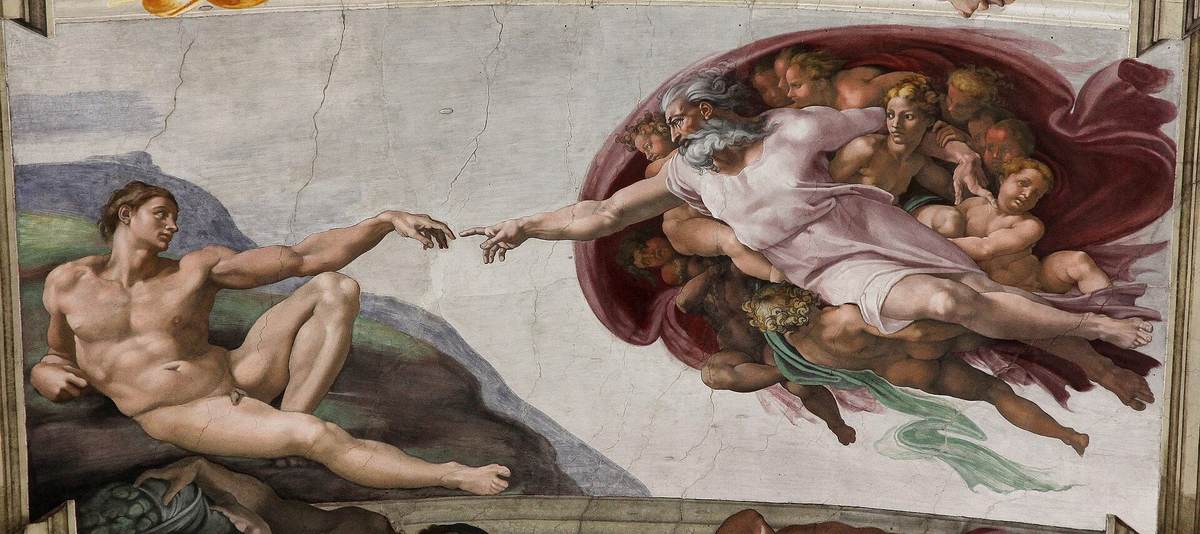
- The Creation of Adam — the fourth panel, and the reason most people look up. Read our full analysis of the Creation of Adam and its anatomical reading.
- The Creation of Eve — the exact centre of the ceiling, which some scholars read as the theological hinge of the whole scheme.
- The Temptation and Expulsion — two moments in one frame, split by the tree.
- The Sacrifice of Noah.
- The Flood — the first panel he painted and the most crowded; a section fell in 1797 after a nearby powder magazine exploded.
- The Drunkenness of Noah — humanity at its lowest, placed nearest the door.
Because he began at the entrance and worked towards the altar, the figures grow larger and looser as the sequence runs backwards. Compare the fussy crowds of The Flood with the single sweeping God of the Separation of Light: you are watching a painter learn fresco in public.
Prophets, sibyls and ignudi
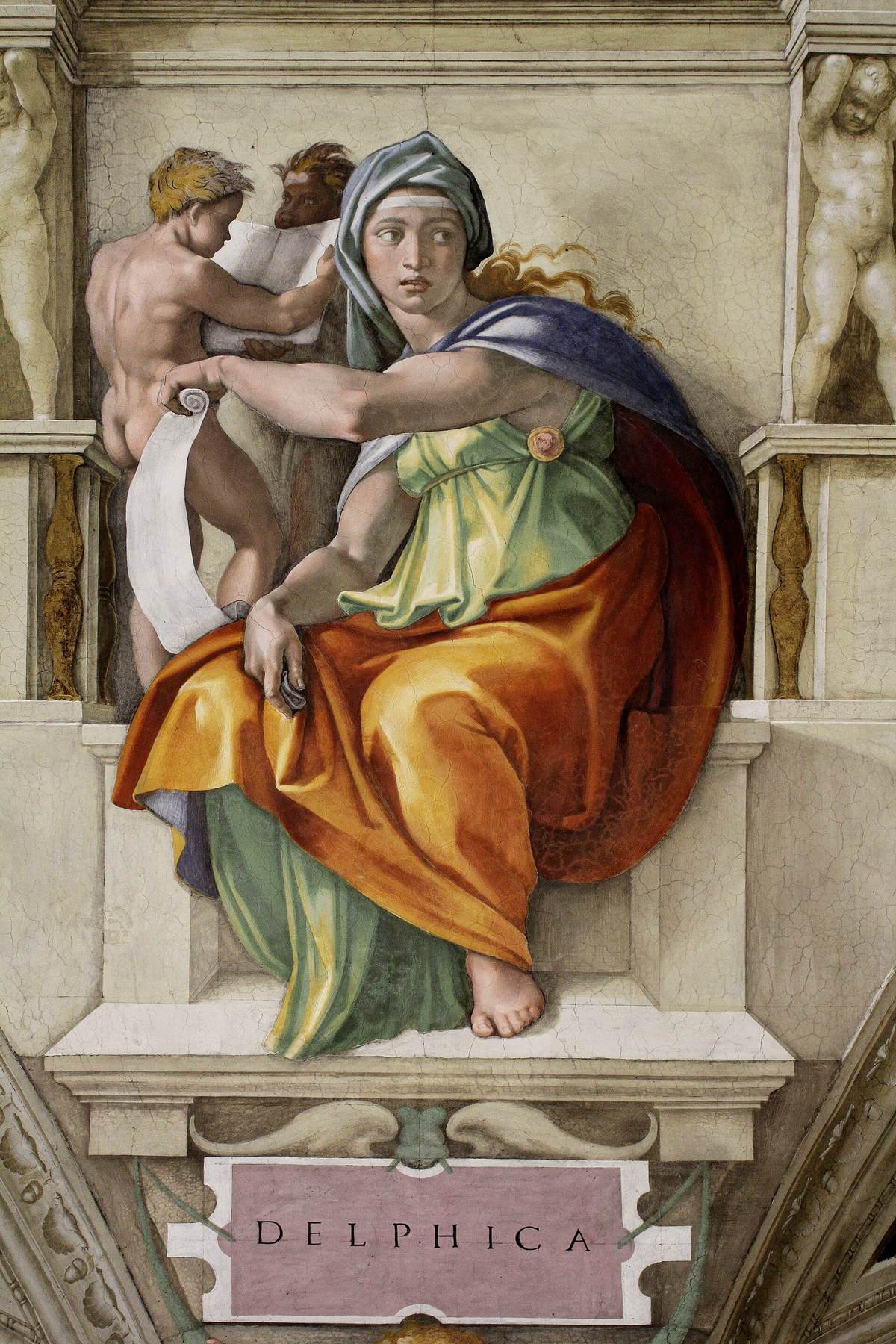
Around the Genesis panels sit seven Hebrew prophets and five pagan sibyls, each more than three metres tall. The Libyan Sibyl twists impossibly to set down her book — a red chalk study for her survives in the Metropolitan Museum of Art in New York. The Delphic Sibyl, near the entrance, is the one most visitors photograph in reproduction. Jonah sits directly above the altar, thrown backwards, his body seeming to push the vault upwards.
Between them are the twenty ignudi, nude young men holding bronze medallions. They serve no clear scriptural purpose, and arguments about their meaning have run for four centuries.
The Last Judgment on the altar wall
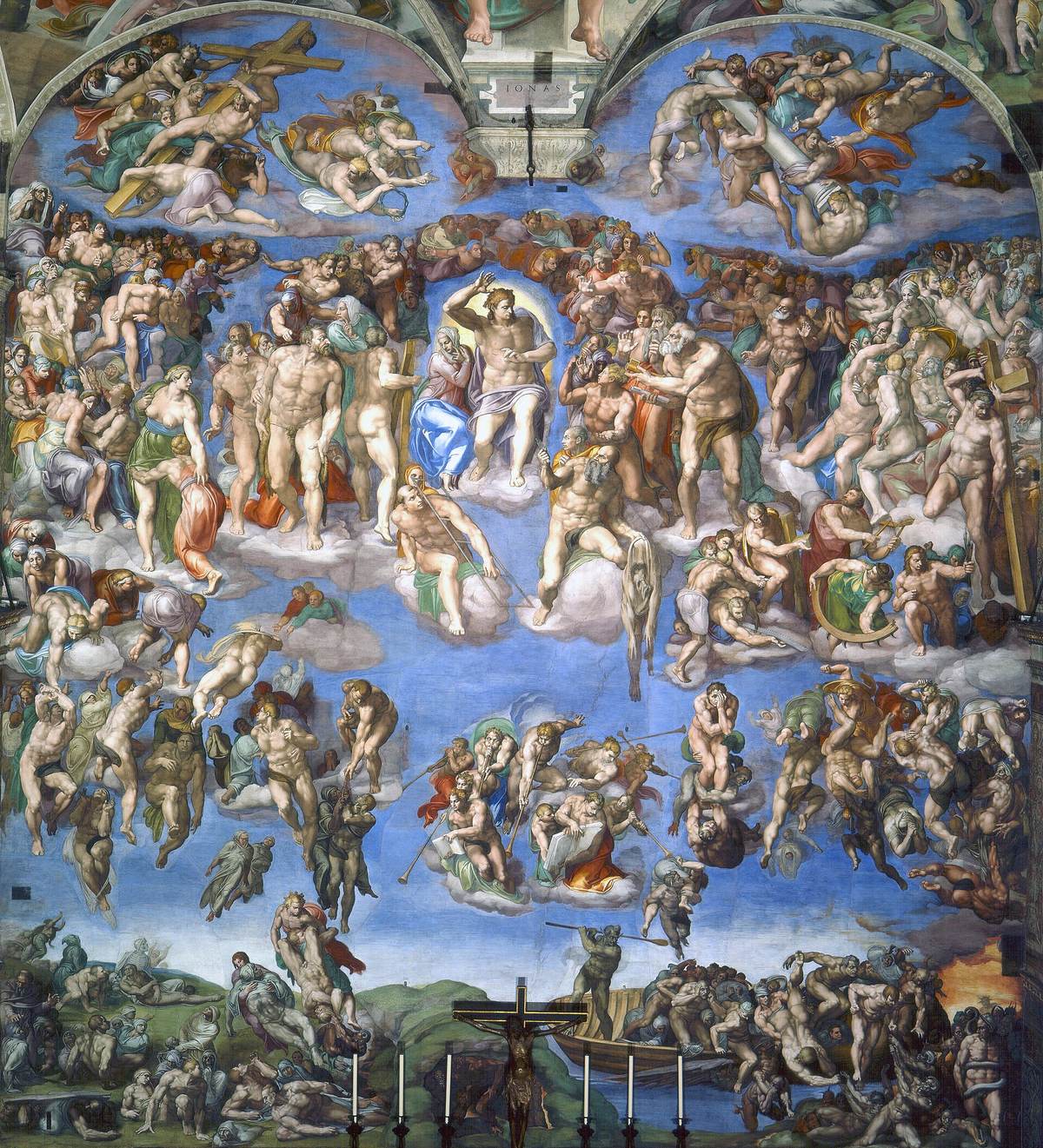
The Last Judgment is a single fresco of roughly 13.7 by 12 metres, painted between 1536 and 1541 for Popes Clement VII and Paul III. Michelangelo was in his sixties and the mood is nothing like the ceiling: no frames, no architecture, just some 300 bodies rising and falling around a beardless, athletic Christ.
- Saint Bartholomew, below and to the right of Christ, holds his own flayed skin. The distorted face on the skin is widely read as Michelangelo's self-portrait.
- Charon and Minos, bottom right, come straight out of Dante rather than scripture. Minos wears the features of Biagio da Cesena, the papal master of ceremonies who complained the fresco belonged in a bathhouse.
- The trumpeting angels, centre bottom, carry two books: a small one for the saved and a much larger one for the damned.
- The draperies added by Daniele da Volterra after 1564 are visible if you look for the sharper, flatter paint over some 40 figures.
The walls almost everyone ignores
In 1481–82, before Michelangelo, Pope Sixtus IV hired the best fresco painters in Italy for the side walls: Pietro Perugino, Sandro Botticelli, Domenico Ghirlandaio, Cosimo Rosselli and Luca Signorelli. They painted two parallel cycles — the Life of Moses on the left and the Life of Christ on the right — so that each Old Testament scene faces its New Testament echo.
The single most important panel is Perugino's Delivery of the Keys, on the right wall. Christ hands the keys to Saint Peter in front of a perfectly ordered piazza, and it is the visual argument for papal authority on which the whole room rests. Botticelli's Trials of Moses and Punishment of Korah are close behind. Look at the painted curtains along the lower wall too: they imitate the tapestries designed by Raphael in 1515, now displayed in the Vatican Pinacoteca.
Where to stand
Stand near the marble screen roughly two thirds down the chapel, facing the altar wall. From there the Genesis panels read in the order Michelangelo painted them and the Last Judgment is seen whole. The side benches are the only seating and free up regularly. If the room is packed, move towards the entrance end and look up rather than fighting towards the altar.
Questions about the artwork
What is the most famous painting in the Sistine Chapel?
The Creation of Adam, painted by Michelangelo around 1511, is the most famous image in the Sistine Chapel. It sits in the fourth of nine Genesis panels on the ceiling, near the centre of the room, and shows God reaching towards Adam with their fingertips almost but not quite touching.
Where should you stand in the Sistine Chapel?
Stand near the marble screen roughly two thirds down the chapel, facing the altar wall. From there the Genesis panels read in the order Michelangelo painted them and the Last Judgment is seen whole. The side benches are the only seating and free up regularly.
Why did Michelangelo paint clothing over the Last Judgment figures?
He did not. After Michelangelo's death in 1564, the Council of Trent ordered the nudity covered, and his pupil Daniele da Volterra painted draperies over about 40 figures. Romans nicknamed him Il Braghettone, the breeches maker. Some additions were removed during the 1980 to 1994 restoration.
For the story behind these commissions, read the history of the Sistine Chapel. For practical planning, see tickets and opening times.
Twelve things to find
- The Creation of Adam
- The Creation of Eve, dead centre
- The Separation of Light from Darkness
- The Libyan Sibyl's twist
- The prophet Jonah above the altar
- The ignudi and their medallions
- Saint Bartholomew's flayed skin
- Minos with donkey ears
- Charon's boat
- Perugino's Delivery of the Keys
- Botticelli's Punishment of Korah
- The painted trompe-l'oeil curtains