Background
The history of the Sistine Chapel
The Sistine Chapel was built between 1473 and 1481 for Pope Sixtus IV as the principal chapel of the Apostolic Palace, and consecrated on 15 August 1483. Its walls were painted by the leading fresco painters of the day, its ceiling by Michelangelo, and its altar wall by Michelangelo again a generation later. It has hosted every papal conclave since 1878.
A chapel built to Solomon's measurements
Sixtus IV della Rovere became pope in 1471 and inherited a crumbling medieval chapel, the Cappella Magna. He replaced it with a fortified hall whose interior measures 40.9 metres by 13.4 metres, with a vault 20.7 metres high — proportions that correspond to the dimensions given for the Temple of Solomon in the First Book of Kings. The message was deliberate: this was the new temple, and the pope its high priest.
The architect is usually identified as Baccio Pontelli; Giovannino de' Dolci ran the site. The exterior is deliberately plain, closer to a barracks than a basilica, with thick walls and a guard walk above. Inside, a marble screen by Mino da Fiesole and Andrea Bregno divided clergy from laity, and a cosmatesque pavement of coloured marble was laid in the medieval Roman tradition.
1481–82: the first fresco campaign
Sixtus IV assembled an extraordinary team from Florence and Umbria: Pietro Perugino as lead, with Sandro Botticelli, Domenico Ghirlandaio, Cosimo Rosselli, Luca Signorelli and Bartolomeo della Gatta. Their contract, dated October 1481, specified ten scenes. They delivered two matched cycles — the Life of Moses and the Life of Christ — running down the side walls so that each pairing argues that Christ fulfils the Law, and that Peter, and therefore the pope, inherits the authority of Moses.
The original ceiling, painted by Piermatteo d'Amelia, was a simple blue sky scattered with gold stars.
1508–1512: Michelangelo and the vault
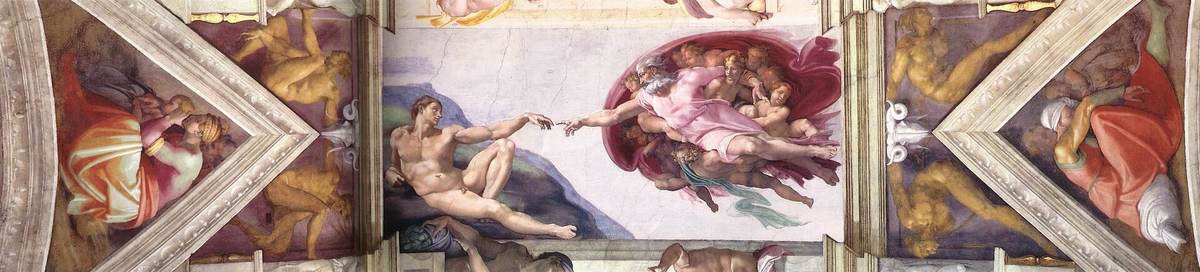
Pope Julius II, nephew of Sixtus IV, commissioned Michelangelo in 1508. Michelangelo, then 33, had been working on the pope's tomb and regarded the ceiling as a distraction — he signed letters of the period simply as a sculptor. He rejected Bramante's proposal for a suspended scaffold, designed his own bracket system resting on corbels in the wall, and painted standing with his head tilted back, a posture he described in a comic sonnet as leaving his beard pointing at heaven and his brush dripping in his face.
The first section, The Flood, developed mould and had to be partly redone; Michelangelo adjusted his plaster mix and carried on. He dismissed most of his Florentine assistants early. By the time he reached the altar end in 1512 he was painting figures two and three times the scale of his first attempts. The ceiling was unveiled on 31 October 1512.
1536–1541: The Last Judgment
Clement VII commissioned the altar wall shortly before his death in 1534; Paul III saw it through. To make room, two of Perugino's frescoes and two lunettes Michelangelo had painted himself were destroyed, and the wall was rebuilt with a slight overhang to shed dust. Michelangelo worked from 1536 to 1541, unveiling the fresco on 31 October 1541, twenty-nine years to the day after the ceiling.
Reaction split immediately. Biagio da Cesena, the papal master of ceremonies, called it fit for a public bathhouse; Michelangelo painted him into hell as Minos with donkey ears. In 1564, weeks after Michelangelo's death, the Council of Trent ordered the nudity covered. Daniele da Volterra added draperies to around 40 figures and earned the nickname Il Braghettone. Further overpainting continued into the eighteenth century.
Damage, conclaves and neglect
The chapel has not led a quiet life. During the Sack of Rome in 1527, imperial troops used the Vatican as a barracks. In 1797 an explosion at the Castel Sant'Angelo powder magazine shook down a section of The Flood. Centuries of candle smoke, charcoal braziers and animal-glue varnishes applied by restorers turned the frescoes brown; by the 1970s most visitors assumed Michelangelo had been a painter of murky earth tones.
From 1878 onwards every papal conclave has been held in the chapel, a tradition formalised by later legislation and now fixed by the apostolic constitution Universi Dominici Gregis. We explain the mechanics in how a papal conclave works inside the Sistine Chapel.
1980–1994: the restoration that changed the picture
Centuries of candle soot, glue varnishes and grime had darkened the frescoes. A restoration ran from 1980 to 1994, funded by Nippon Television Network in exchange for filming rights. Cleaning revealed unexpectedly bright colours — acid greens, salmon pinks, sharp lilacs — and prompted a lasting scholarly debate about how much original surface was lost, particularly the a secco shadows Michelangelo may have added once the plaster dried.
The lunettes were cleaned first, the ceiling completed in 1989, and The Last Judgment unveiled in December 1994. Whatever the arguments, the restored ceiling is what today's visitors see, and it looks nothing like the reproductions printed before 1990.
Timeline
| Year | Event |
|---|---|
| 1473–1481 | Chapel built for Pope Sixtus IV, replacing the Cappella Magna |
| 1481–1482 | Wall frescoes by Perugino, Botticelli, Ghirlandaio, Rosselli and Signorelli |
| 15 August 1483 | Chapel consecrated and dedicated to the Assumption of the Virgin |
| 1508–1512 | Michelangelo paints the ceiling for Julius II |
| 1515 | Raphael designs tapestries for the lower walls |
| 1536–1541 | Michelangelo paints The Last Judgment |
| 1564 | Council of Trent orders draperies; Daniele da Volterra begins work |
| 1797 | Explosion damages part of The Flood |
| 1878 | First of the modern conclaves held in the chapel |
| 1980–1994 | Full restoration funded by Nippon Television Network |
| 2014 | New LED lighting and climate control installed to protect the frescoes |
History questions
Who built the Sistine Chapel and when?
The Sistine Chapel was built between 1473 and 1481 for Pope Sixtus IV, who gave it his name. The design is attributed to the architect Baccio Pontelli and the construction was supervised by Giovannino de' Dolci. It was consecrated on 15 August 1483.
How long did Michelangelo take to paint the Sistine Chapel ceiling?
Michelangelo painted the ceiling in about four years, from May 1508 to October 1512. He worked standing on a bracket scaffold he designed himself, and painted roughly 460 square metres containing more than 300 figures, largely with a small team of assistants.
Why was the Sistine Chapel restored?
Centuries of candle soot, glue varnishes and grime had darkened the frescoes. A restoration ran from 1980 to 1994, funded by Nippon Television Network in exchange for filming rights. Cleaning revealed unexpectedly bright colours and prompted a lasting scholarly debate about how much original surface was lost.
Continue with our guide to the frescoes worth finding inside the chapel, or start planning with visiting information.
Sources consulted
- Musei Vaticani official collection notes on the Cappella Sistina
- Giorgio Vasari, Lives of the Artists, 1568 edition
- Vatican Museums restoration reports published during the 1980–1994 campaign
- Metropolitan Museum of Art catalogue entry for the Libyan Sibyl study
Key figures
- Pope Sixtus IV
- Commissioned the chapel, 1473
- Baccio Pontelli
- Architect of the structure
- Pietro Perugino
- Led the 1481–82 wall cycle
- Michelangelo Buonarroti
- Ceiling 1508–12, Last Judgment 1536–41
- Daniele da Volterra
- Added draperies from 1564