Art analysis
The Creation of Adam, explained panel by panel
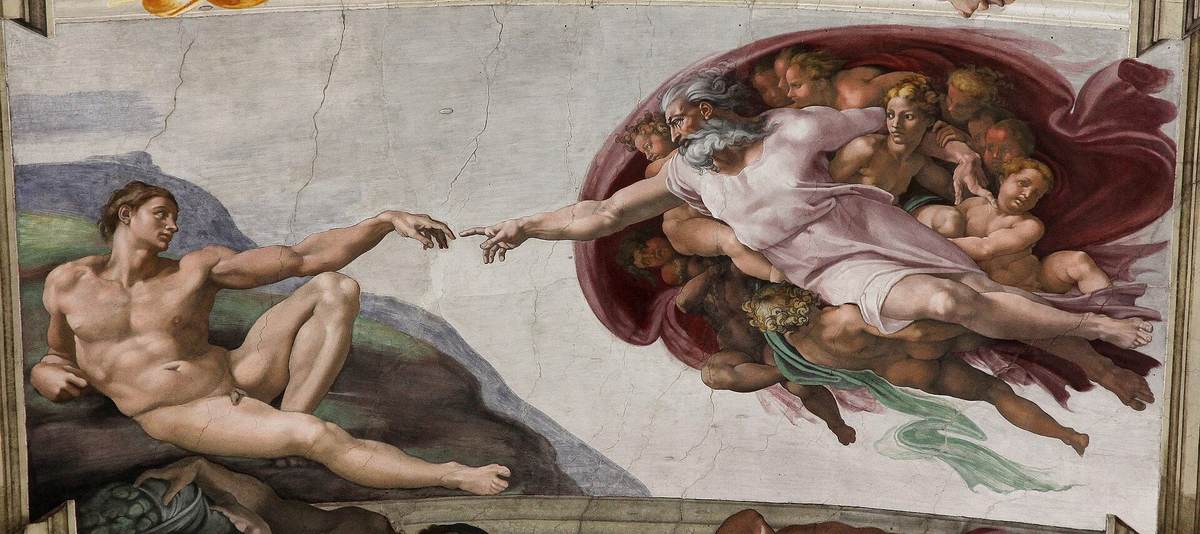
The Creation of Adam is a fresco painted by Michelangelo Buonarroti around 1511 on the ceiling of the Sistine Chapel. It measures roughly 280 by 570 centimetres, occupies the fourth of nine Genesis panels, and shows God the Father reaching towards a reclining Adam with their index fingers almost touching.
Key facts
- Artist: Michelangelo Buonarroti, aged about 36
- Date: circa 1511, within the 1508–1512 ceiling campaign
- Size: approximately 280 × 570 cm
- Technique: buon fresco on wet plaster, with limited a secco retouching
- Location: fourth Genesis panel, Sistine Chapel ceiling, Vatican City
What the panel shows
On the right, God the Father is carried through a void by a swarm of figures wrapped in a billowing red-violet mantle. His right arm extends towards Adam. Under his left arm sits a young woman, usually identified as Eve before her creation, looking out at Adam with unmistakable curiosity; some scholars read her instead as the Virgin Mary, with the child at God's knee as Christ.
On the left, Adam lies on a bare slope of earth, already fully formed but not yet animated. His body is heavy, his arm resting on his raised knee, his finger lifted but slack. Michelangelo has painted the moment the current is about to arrive rather than the moment it does.
Why the fingers do not touch
The gap is deliberate. Michelangelo shows the instant before contact, so the fresco depicts potential rather than completed creation. God's arm is fully extended while Adam's is limp, which makes the divine act the active force and Adam the figure still waking into life. Everything in the composition funnels the eye into that few centimetres of empty plaster: the two diagonals of the bodies, the sweep of the mantle, the line of the hillside.
It is worth remembering the panel sits some 20 metres above the floor. From the chapel benches the gap reads as a spark, not a measurement. That is a deliberate calculation by a painter who complained bitterly about the commission but understood the room perfectly.
The brain theory
It is a theory, not an established fact. In 1990 the physician Frank Lynn Meshberger argued in the Journal of the American Medical Association that the red mantle around God matches a cross-section of the human brain, with the figures corresponding to anatomical structures such as the pons and the optic chiasm. Later writers extended the idea to a uterus, a lung and a kidney.
Michelangelo certainly dissected corpses: Vasari and Condivi both record it, and the anatomical precision of his figures is not accidental. But there is no letter, sketch or contemporary account linking the mantle to a brain, and the shape is also perfectly explicable as the standard Renaissance device for divine flight. Treat the theory as an interesting reading rather than a settled fact, and be sceptical of guides who present it as one.
Where the panel sits in the wider scheme
The nine Genesis panels run from the altar to the entrance in narrative order, but Michelangelo painted them in reverse, beginning with The Flood above the door in 1508 and ending with the Separation of Light from Darkness above the altar in 1512. The Creation of Adam falls near the middle of both the room and the campaign, and you can see the shift: figures are larger, groups are simpler, and the storytelling is stripped to essentials compared with the crowded early panels.
| Panel | Painted | Figures | Character |
|---|---|---|---|
| The Flood | 1508–09 | 60 plus | Crowded, small-scale, narrative |
| The Temptation and Expulsion | 1509–10 | 7 | Two moments, one frame |
| The Creation of Adam | circa 1511 | 14 | Monumental, reduced to essentials |
| The Separation of Light from Darkness | 1512 | 1 | Painted in a single giornata, near-abstract |
How it was painted
The Creation of Adam is buon fresco: pigment applied to wet lime plaster, which then cures and binds the colour into the wall. Painters worked in daily sections called giornate, and the joins between them are still visible under raking light. Restorers counted the giornate across the ceiling during the 1980–1994 cleaning, and the figure of Adam was completed in a small number of them — the head, according to published restoration records, in a single day.
Michelangelo transferred his cartoons by pouncing charcoal through pricked holes and by incising outlines directly into the plaster. Both marks survive and were documented during the restoration.
What the restoration changed
Before 1980, reproductions of this panel showed sombre, smoky tones. The cleaning removed candle soot and animal-glue varnishes applied by earlier restorers, and the underlying colours turned out to be far lighter: Adam's flesh warm and pink, the mantle a clear red-violet, the sky a flat grey-green. The debate about whether cleaners also removed Michelangelo's own a secco shadows has never fully resolved, and it is a fair thing to raise with any guide who tells you the ceiling is exactly as painted.
Seeing it in the chapel
- Enter and walk about two thirds of the way towards the altar, then turn to face the entrance end.
- Look for the panel in the upper middle of the vault: God on the right, Adam on the left.
- Give your neck a break by using the side benches if a space opens.
- Then look at the neighbouring Creation of Eve, at the exact centre of the ceiling — the panel Michelangelo's scheme arguably builds around.
Remember that photography is banned inside the chapel, so look properly rather than through a screen. Our highlights guide lists eleven other things worth finding, and the visiting information page covers the rules enforced inside.
Questions about the Creation of Adam
When did Michelangelo paint the Creation of Adam?
Michelangelo painted the Creation of Adam around 1511, in the second half of his ceiling campaign of 1508 to 1512. It occupies the fourth of nine Genesis panels and measures roughly 280 by 570 centimetres on the vault of the Sistine Chapel.
Is there a brain hidden in the Creation of Adam?
It is a theory, not an established fact. In 1990 the physician Frank Lynn Meshberger argued in the Journal of the American Medical Association that the red mantle around God matches a cross-section of the human brain. Art historians remain divided, and no document from Michelangelo supports it.
Why are Adam and God's fingers not touching?
The gap is deliberate. Michelangelo shows the instant before contact, so the fresco depicts potential rather than completed creation. God's arm is fully extended while Adam's is limp, which makes the divine act the active force and Adam the figure still waking into life.
In this article
- What the panel shows
- Why the fingers do not touch
- The brain theory, assessed
- Its place in the ceiling
- Fresco technique and giornate
- Effects of the restoration